


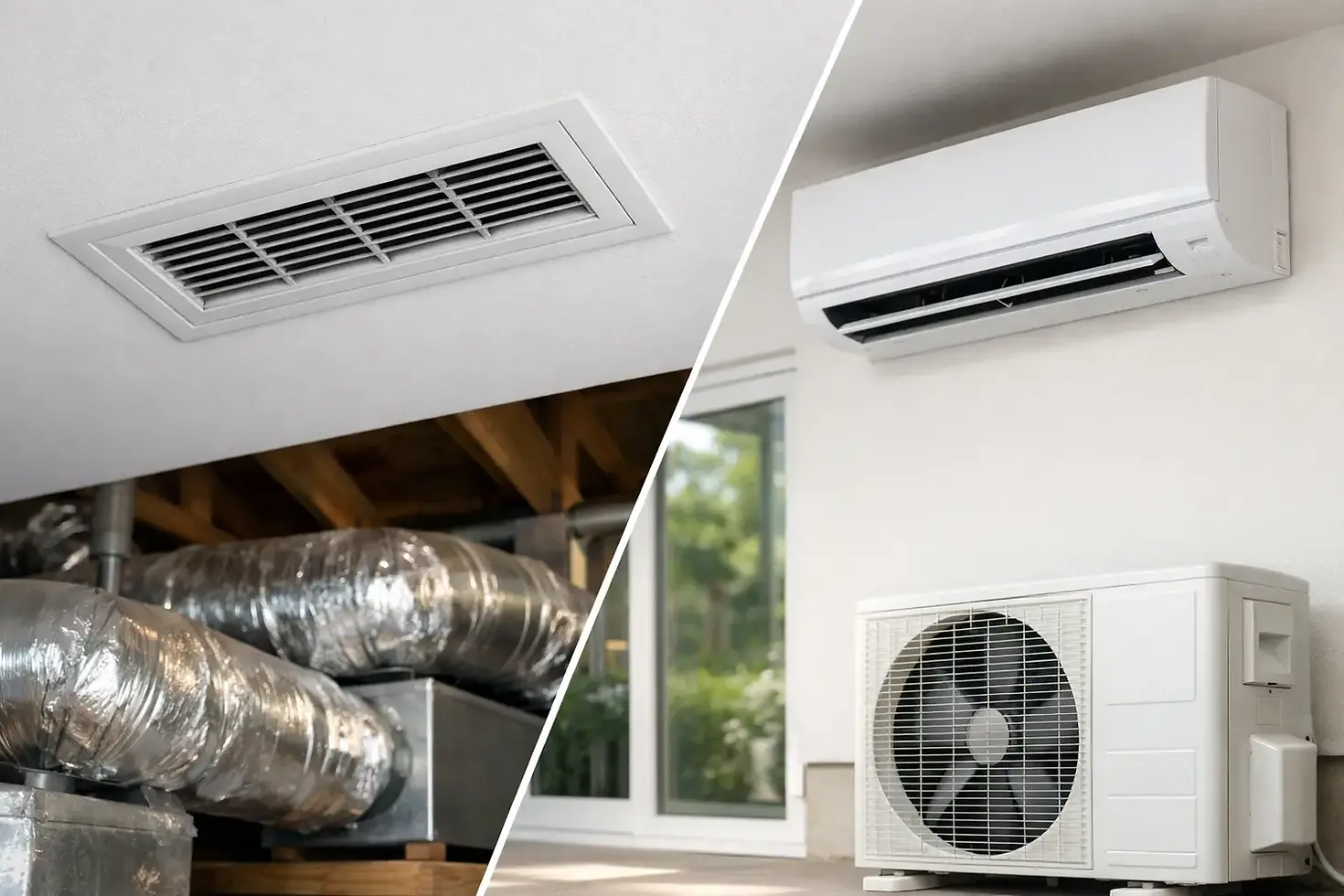
Ducted Versus Mini Split: Which Fits?
If your home has hot upstairs bedrooms, a chilly basement, or an older furnace that keeps getting more expensive to run, the ducted versus mini split question usually shows up fast. Both systems can heat and cool efficiently. The better choice comes down to your layout, your budget, and how you actually use each room day to day.
For homeowners across Vancouver Island, that decision is rarely one-size-fits-all. A newer build with existing ductwork has very different needs than a character home in Duncan, a rancher in Nanaimo, or a renovation project in the Cowichan Valley. The right answer is the one that gives you reliable comfort without overspending on equipment you do not need.
Ducted versus mini split: the basic difference
A ducted heat pump uses a central air handler and a network of ducts to move heated or cooled air throughout the home. It works a lot like a traditional forced-air furnace setup, but with far better energy performance when properly designed and installed.
A mini split, also called a ductless heat pump, delivers heating and cooling directly into individual rooms or zones. Instead of using ducts, it relies on indoor wall-mounted, floor-mounted, or concealed units connected to an outdoor unit.
The biggest practical difference is control. Ducted systems treat the home more like one connected space. Mini splits give you room-by-room flexibility. Neither approach is automatically better. It depends on how your home is built and what kind of comfort problems you are trying to solve.
When a ducted system makes more sense
If your home already has good ductwork in place, a ducted system often becomes the cleaner upgrade path. You can keep the familiar whole-home airflow people are used to, while replacing an aging furnace or air conditioner with a more efficient heat pump.
Ducted systems also make sense for homeowners who want a consistent look with no visible wall units. Everything stays hidden behind ceilings, walls, and vents. In larger homes, especially homes with multiple bedrooms and open shared areas, that can feel more natural than installing several indoor ductless heads.
There is also the comfort factor. A well-designed ducted system can deliver more even air distribution across the house. If you want one thermostat, one integrated system, and a more traditional whole-home setup, ducted often checks those boxes.
That said, the phrase well-designed matters. If the existing ducts are undersized, leaky, poorly routed, or located in unconditioned spaces, performance can suffer. In those homes, keeping old ductwork just because it is there is not always the best long-term move.
Best-fit homes for ducted heat pumps
Ducted systems are usually a strong option in newer homes, homes with existing forced-air heating, and larger houses where a central system can serve most rooms efficiently. They also suit homeowners who prefer hidden equipment and a single control point.
For some families, ducted is the easier lifestyle fit. You do not have to think as much about which zones are running or whether a guest room needs its own head unit. The system is designed to cover the full house more uniformly.
When a mini split makes more sense
Mini splits are often the better answer when a home has no ducts, limited space for renovations, or distinct hot and cold spots that need targeted control. They are especially common in older homes, additions, suites, and retrofit projects where installing full ductwork would be expensive or disruptive.
A mini split lets you heat and cool the areas you use most without paying to condition every room the same way. That can be a real advantage in homes where one level gets more sun, one room is rarely occupied, or family members prefer different temperatures.
They can also be a very practical solution for staggered upgrades. Some homeowners start with the main living area and primary bedroom, then expand later if needed. That kind of flexibility is harder to achieve with a central ducted system.
The trade-off is visible indoor equipment. Some people do not mind wall-mounted units at all. Others strongly prefer the cleaner look of vents and hidden components. Neither reaction is wrong. It is simply part of the decision.
Best-fit homes for mini splits
Mini splits are often ideal in older houses without ducts, smaller homes, basement suites, garages converted to living space, and homes with hard-to-balance temperatures. They are also a good fit when energy savings depend on zoning rather than conditioning the entire home the same way.
If one part of your house always feels uncomfortable, a mini split can solve that problem directly instead of trying to force a central system to do something the layout does not support well.
Cost: upfront price versus long-term value
For many homeowners, cost is where the ducted versus mini split decision gets serious. Upfront pricing depends on home size, electrical needs, equipment brand, installation complexity, and whether ductwork already exists.
If your home has no ducts, adding a full ducted system can be a major project. In that case, mini splits often come in at a lower installation cost. If you already have usable ductwork and need a whole-home replacement, ducted may be more cost-effective than installing multiple indoor ductless heads.
Operating cost is more nuanced. Both systems can be highly efficient. Mini splits can have an edge when zoning reduces wasted energy in unused rooms. Ducted systems can perform very well too, especially in homes where the whole house is occupied consistently and the duct design is tight and properly sized.
This is also where rebates matter. In British Columbia, heat pump incentives can change the math significantly. A system that looks expensive at first can become much more attractive once eligible rebates are factored in. Working with a rebate-approved installer helps make sure the system is chosen and installed to meet program requirements.
Comfort and control in real homes
Efficiency numbers are useful, but homeowners usually care most about how the house feels. Does the bedroom stay comfortable at night? Does the main floor overheat in summer? Does the system recover quickly after a cold snap?
Ducted systems tend to deliver a more uniform whole-home experience. Mini splits tend to deliver more precise zone control. If your family spends most of its time in a few key rooms, mini splits can be a smart way to match comfort to your routine. If every bedroom, hallway, and living area needs consistent conditioning, ducted may feel more complete.
Noise can also differ. Both modern systems are much quieter than older equipment, but mini split indoor heads are located in the room, while ducted airflow is heard mainly at registers. In homes where aesthetics and room-by-room noise sensitivity matter, that detail can influence the final choice.
Installation impact and maintenance
A ducted installation can be straightforward or invasive depending on the home. Replacing an existing furnace with a compatible ducted heat pump is one thing. Adding ducts to an older home is another. Access, ceiling cavities, crawlspaces, and wall construction all affect labor and final cost.
Mini splits are usually less disruptive to install. They require refrigerant lines, electrical connections, and mounting locations for indoor units, but not full duct runs through the house. For retrofit projects, that simplicity is a major reason homeowners choose them.
On maintenance, both systems need regular service. Filters, coils, refrigerant charge, condensate drains, and overall performance should be checked routinely. Ducted systems may also need duct inspection and cleaning over time. Mini splits require homeowners to keep indoor heads clean and unobstructed.
Neither system should be thought of as install-it-and-forget-it equipment. Good maintenance protects efficiency, comfort, and equipment life.
Which system is better for Vancouver Island homes?
In many Vancouver Island homes, the answer is not about which technology is better overall. It is about which one suits the home you already have. Our climate makes heat pumps a strong fit, but layout, insulation, window exposure, and existing mechanical systems still matter.
If you have a forced-air setup and want a clean whole-home solution, ducted may be the right move. If you are upgrading an older house without ducts, solving uneven temperatures, or trying to control costs during a renovation, a mini split may offer better value.
There are even cases where a hybrid approach makes sense. A ducted system might handle the main living areas while a ductless unit supports an addition, upstairs zone, or suite. That is why an in-home assessment matters more than a generic online comparison.
At C & S Heating & Cooling, we see this every day. The best results come from matching the system to the house, the budget, and the family using it - not from forcing every home into the same recommendation.
If you are weighing ducted versus mini split, the smartest next step is to get a quote based on your actual home. A good HVAC plan should make comfort simpler, lower operating costs where possible, and give you confidence that the system will keep up when you need it most.


Comments